Ancient Coins
The Committee for the Commemoration of Veronese Easters has also reproduced ancient Venetian and Della Scala coins, representing the Lords of Verona during the Middle Ages.
Each coin comes with an explanatory legend, available in Italian and English.
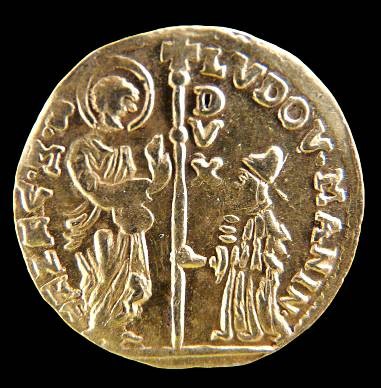
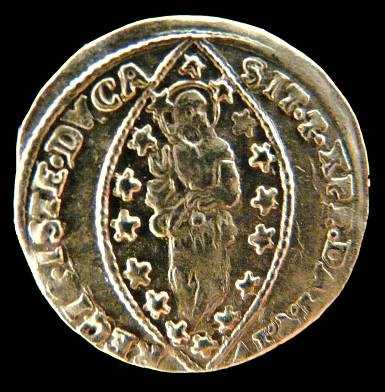
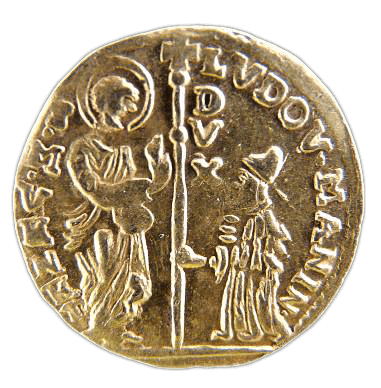
Venetian Zecchino
The term Zecchino derives from zecca, the Venetian State Mint where ducal coins were struck.
Obverse: the Doge kneels before Saint Mark, the principal Patron of the Serenissima, and holds the processional cross with his left hand while Saint Mark stands, blessing him.
Reverse: Christ, facing forward within a mandorla surrounded by sixteen stars, blessing with his right hand and holding the Gospel in his left.
The enclosed mandorla symbolizes the mystery of Christ’s Resurrection.
Between the 12th and 13th centuries, Genoa and Florence first minted their gold coins, the genovino and the florin, followed on October 31, 1284, under Doge Giovanni Dandolo, by the Venetian gold ducat, or zecchino.
It weighed 3.5 grams of gold (purity 997/1000) and remained unchanged until the fall of the Republic in 1797.
It was accepted worldwide, even in non-Christian lands, despite bearing the image of the Redeemer.
Indeed, 20% of the world’s gold at the time was used for its minting.
A single zecchino could pay for a moderately valuable purchase (a non-luxury garment, a fine dinner among friends, etc.), roughly equivalent to four days’ wages for a common worker.
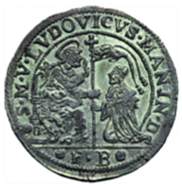
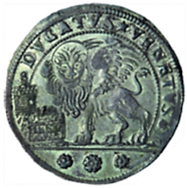
Silver Ducat
Obverse: the Doge, kneeling, receives from Saint Mark — seated and richly robed — the oriflamme surmounted by a cross, both holding it with their left hands.
At the bottom appear the initials F. B. (Francesco Barbaro), the last massaro (State official in charge of the mint) of the Republic.
Reverse: the winged and haloed Lion, symbol of Saint Mark, rests its front paw on the open Gospel.
In the background, on the left, stands a tower, representing the Republic’s mainland dominions.
Scaliger Grosso
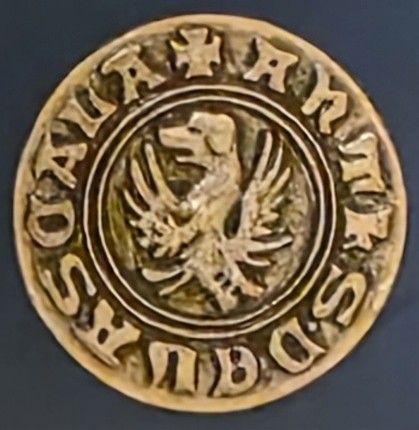
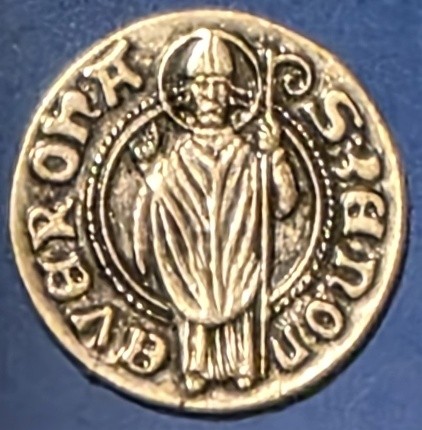
The Grosso (“large coin”) worth two soldi, issued by Antonio Della Scala, Lord of Verona from 1381 to 1387.
Obverse: a helmet topped with a crest depicting a winged dog, from which hangs a ladder, emblem of the Della Scala family, surrounded by the prince’s name.
Reverse: Saint Zeno (+372), Bishop and Patron Saint of Verona and its diocese, wearing a mitre, holding a pastoral staff in his left hand, and blessing with the right.