The outrageous Napoleonic celebrations in Verona and Rivoli Veronese contested
DOUBLE PROTEST AGAINST THE OUTRAGEOUS NAPOLEONIC CELEBRATIONS IN VERONA AND RIVOLI VERONESE
A two-day Napoleonic event was organized by the Municipality of Rivoli Veronese on May 4–5, 2023, to celebrate Bonaparte on the anniversary of his death and to install a commemorative plaque in praise of him in the town’s central square, in front of the Town Hall: a square already named after Napoleon I, Emperor.
The plaque was placed on the façade of the Rivoli Town Hall and dedicated to Bonaparte, the destroyer of the Venetian Homeland and of traditional Catholic Italy, once structured in its legitimate institutions, deeply loved by the people. These same people rose up repeatedly in defense of their faith and institutions between 1796 and 1814: an estimated 250,000 dead, according to the most conservative figures,50 times the deaths of the so-called Risorgimento and 20 times those of the so-called Resistance (1943–45), in an Italy that then had only one-third of the population it would have in later centuries.
Before the inaugural ceremony, the plaque was covered with the blue starred flag of the European Union, a neo-Jacobin institution, if not neo-Soviet and entomophagous (insect-eating), seen as an oppressive outgrowth of the U.S. military occupier and of the liberal-Masonic powers that usurp authority over the ancient and noble European continent and the world.
This is the text of the hagiographic inscription installed in Rivoli, seemingly referring more to the Emperor of the French than to the Republican General, inaugurated yesterday, May 5, 2023, at 6:00 p.m., and corrected by a providential, though unintentional, typographical improvement by the stonemason:
(municipal coat of arms above)
Municipality of Rivoli Veronese
PIAZZA NAPOLEONE I
“In these places was born the era [read: the epic] of General Buonaparte who, after Rivoli, became for all Napoleon.”
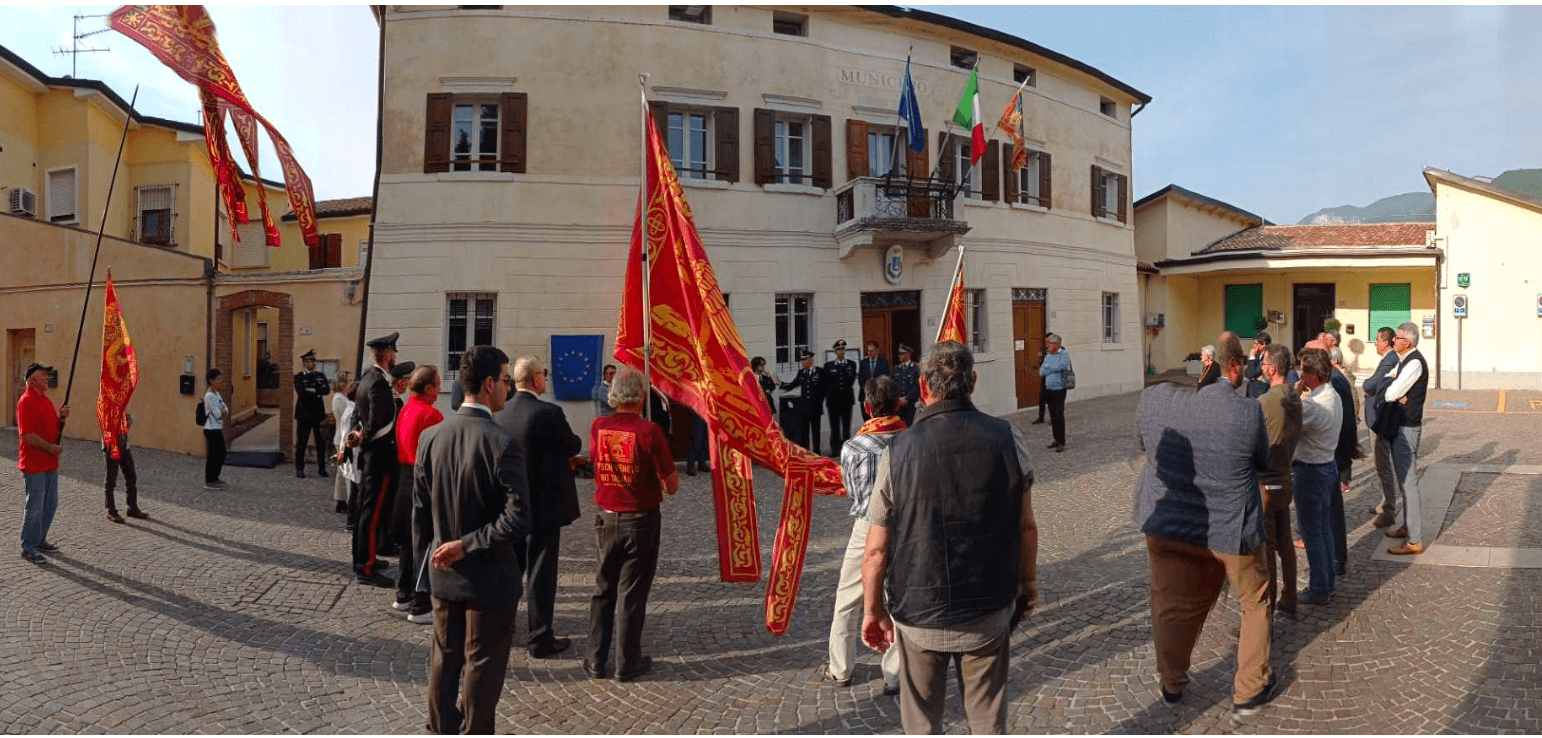
The chauvinist ceremony in Rivoli, attended only by local administrators and members of the Comunità Montana del Baldo Garda, the new Police Commissioner of Verona Roberto Massucci, as well as Generals and Officers of the Carabinieri Corps and the Guardia di Finanza, was boycotted by the population.
No resident of Rivoli, nor of the Adige Valley or the surrounding municipalities, showed up.
An embarrassing situation for everyone, especially the organizers, who failed to summon schoolchildren (or university students with the promise of extra credits, as is often done at academic conferences).
Moreover, the Napoleonic glorification was peacefully protested by members of the Committee for the Commemoration of the Pasque Veronesi, assisted by activists from the Veneto National Liberation Committee, who waved Marcian flags in protest.
They distributed leaflets and spoke alongside the organizers, openly criticizing the celebration of the Corsican despot.
Rivoli still has some nostalgics of the column erected in 1806, years after the battle fought on January 14–15, 1797, which was demolished by the Imperial troops of the Austrian Emperor (the good and true one) in 1814.
The widows of Bonaparte including the French Consul, local administrators, and historians , would even like to rebuild that monument, of which only fragments remain today, and to which they have dedicated blandly hagiographic essays (such as that by Luca Gandini).
Not only that: some are even considering erecting a new statue dedicated to the great usurper of France and Europe, which is already completed, sculpted by local artisans.
This recalls what happened, amid fierce controversy, in Venice in 2002, when the city and its galleries purchased at a Sotheby’s auction in London a statue by Domenico Banti, once smashed by the Venetian people after Napoleon’s fall.
That statue had been erected in Piazzetta San Marco on August 15, 1811, for his 42nd birthday by servants of the Bonapartist regime.
Recovered from storage, reassembled, and restored, it reappeared first in New York and then in London, before being purchased by the new Bonapartist followers in the lagoon for €353,000, taken from public funds.
In 2002, the protests were so intense that the statue of the tyrant who had destroyed the Serenissima was placed at night and in secrecy inside the Correr Museum, enclosed in a special anti-breakage case, where it remains to this day.